Monday, 31 October 2011

Another poll about food

Am now back from a recent trip stateside. Which, in part, is responsible for the lack of blogging in recent weeks. I got to do both those things that Americans love to do: work hand and impose democracy on a far away country. Only kidding, the two things I am thinking of that Americans love to do are eat far too much and watch TV. I got to eat lots and lots, and I also watched a small amount of TV. Sometimes I even got to combine the two by watching TV whilst eating. Not only that, but on at least one occasion when I wasn't eating, I was watching the food network in my room.

Which reminded my of Rachel Ray.
Rachel Ray. Like really, what are you going to keep in those pockets?
Who is actually some sort of celebrity chef, who totally has a TV show and writes cookbooks and things. I like this acticle about her, particularly the sentence, "Objects derive meaning from their context".

Food shows are vaguely educational right? Although perhaps for TV purposes they get classed as entertainment. But the the thing that grinds my gears about Ray (or Rachel Ray as people like to call her) is that she can't decide how to pronounce endive. Every single time she mentions the vegetable she says "en-dive or on-deev" and makes a failed little joke out of it. I strongly feel she is supposed to be the authority on this recipe she is presenting, but she seems to be admitting her own ignorance. Just pick one and stick to it woman, people will follow you. And if someone writes it to complain about your pronunciation, then you can sit back and smile, smug in the knowledge that they are a tool, and you are far better looking and wealthier than the people that watch your show.

We all know sex and food make a great combination. And I think we should have a poll on the topic. Another celebrity chef who who likes to combine the two is Nigella.

I was about to try and write some words to express my thoughts on the her, but instead I will unashamedly quote from this blog.
When she leaned over to stir the batter for a chocolate cheesecake I swear I could see the cameraman waging a Herculean internal war to remain professional and not fill the screen with her magnificent breasts, and as my own febrile lust reached the boiling point Nigella pulled her wooden spoon from the creamy, russet mixture, trailing a thick bolus of sweetness to her slowly-parting lips and orgasmically sighed “Mmmmmm…” with unbridled sensuality, later punctuated with an equally erotic and drawn-out “Yuuuuuuum.”
I remember seeing a photo of Ainsley wearing nothing but a bunch of grapes. The internet seems incapable of finding this photo for me again, and so I am unable to share it with you. It will just have to remain a happy memory. It is also the sole reason why I think he deserves a spot in the poll.

Giada de Laurentiis is another american who, like Ray, clearly got a job on TV for her culinary knowledge and skills. Sophie Dahl on the other hand is some sort of ex-model who likes food. The rest are just in the poll to make up numbers.

Tuesday, 20 September 2011

What's on TV

Filling the hole left by Thomasina Miers is a new cookery show on Channel 5. The "Real Food Family Cook Off" features well known foodies Matt Dawson, Lisa Faulkner and Anton du Beke. (Fair enough it does have Ainsley Harriot).
Celebrity slapper Matt Dawson MBE had a successful rugby career but has spent the subsequent years faffing around trying to keep his face on TV. He tried dancing and cooking, and now he is trying hosting a food show. If A Question of Sport was Shooting Stars, then Matt Dawson would be Jack Dee.

Anton du Beke is quoted as saying that he can turn anybody into a great dancer. He was also in another cooking show, "Step up to the Plate" with Lloyd Grossman.

Lisa Faulkner used to be a model or some shit. They say don't trust skinny chefs, I guess that might extend to commentary on cookery shows by skeletor.
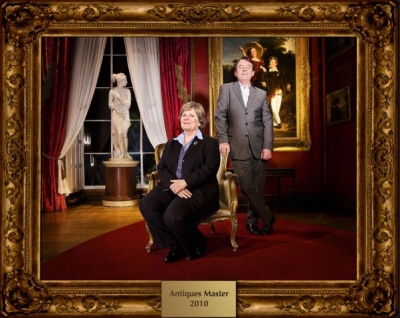
However, this latest competition based show pales into insignificance next to Monday's "gripping" final of Antiques Master. Unfortunately, I was rooting for the lady specializing in antique tiles, who didn't make it to the final.
Celebrity lesbian Sandi Toksvig was an obvious choice to host  Antiques Master

Monday, 19 September 2011

A Note on the Nature of the Universe

Made a discovery this week and I feel it is my duty to share it with the world in the hope that others don't make the same mistake I did.

I had just finished cleaning up after dinner and made a cup of tea, and I knew that a little later on that evening we would be having plum crumble and custard. I figured I would do some preparation and start the custard, then I could sit down for an hour and all I had to do later was press "start" on the microwave. So I mixed the custard powder and sugar and milk and left it in the microwave. Then I could settle down with my tea and not move for a while.

Later I put the second part of my plan into action and turned the microwave on. However things didn't work out quite like I had planned. For it seems that in the hour I was sat watching TV the custard has settled. So when I first checked to see how it was getting on, it was all runny at the top, and proper solid and messed up at the bottom. Perhaps the best thing to do in this situation would have been to scrap it and start again. But I was so looking forward to not having to bend over to get the ingredients out of the cupboard, that I just made the best of what I had. It tasted alright, but it wasn't the lovely velvety custard I was expecting.

Keep this in mind though... The plan might have worked if I had stirred it just before starting to cook it.

Sunday, 28 August 2011

Rhubarb: Part 1

A friend of a friend has an allotment that he shares with this man...

Somehow, I ended up with some rhubarb in my house a few nights ago. And yesterday I made it into a crumble. This experience reminded me how much I like rhubarb, and how I haven't cooked with it for years and years. Like 10 years probably. My parents had some and I used to love eating it. I would pull it, and "top and tail it" and cook with it. I remember having great fun cutting the leaves off with my very sharp knife. I liked to cut the leaves off in one motion, if the knife got stuck and I had to have a second cut then I was very disappointed.

A Plan is Formed

All these thoughts made me really want to grow my own rhubarb. I seem to remember my dad giving me the impression that it was difficult to get it established, but when it was going it would last for ever. That sort of put me off, but no longer. I am going to grow some, and it is going to be fricking awesome. I selected the most suitable part of my garden and got to work straight away the very next day. There were a couple of problems which presented themselves immediately.
  • It is completely the wrong time of year for planting rhubarb.
  • There is a giant bush of some sort in the way.
  • The soil in that area is rubbish. Full of clay and rocks.
However, these three problems sort of work together to give, what I hope will be, a good outcome. I need to improve the quality of the soil, and by the time I have done that it will be march and I can plant away. And the first thing I want to do to improve the soil is get rid of that bush what is sucking all the nutrients out of the clay and rocks.
I never remember to take the "before" photo. So, instead of a "before" and "after", I can present you with a "during" and a "during".
The stump gets the first round, but I'll be back.

This is an artist's impression of what my garden will look like when Project Rhubarb is complete.  As you can tell I am also planning to add a peony. The artist didn't know what a peony looks like, so he added a nebulous green bush with some colourful dots on it.

A Tale Spanning Three Centuries


I spent a fun afternoon at war with the bush. It's hard work replacing a moderately acceptable bush with empty soil soon to be filled with weeds. The task of excavating the giant rootball was made slightly more interesting by the discovery of a Victorian coin. When it was all cleaned up it turns out to be a penny from 1889.

Difficult to believe, I know, but my kitchen work surfaces aren't actually marble. Instead they are MDF with a clever marble-effect surface.

Wednesday, 24 August 2011

Speed Cameras

I really struggle to understand how people can complain about speed cameras. Firstly, and most importantly they reduce death and injury. That should be all that needs to be said on the matter.

However, people do complain about them, and some people intentionally damage them. So perhaps we should say more about them...

The way I see it, complaining about speed cameras is tantamount to admitting that you drive too fast. Everybody thinks they are driving safely and don't like to be told otherwise. (The only people who don't think they are driving safely are involved in some sort of high speed chase and no amount of cameras or speed limits will change the way they are driving.) But of course, they are wrong, which is why there are so many accidents and deaths and injuries.

The second argument against speed cameras is that councils are using them to make money. Like that is a bad thing? I really don't have any problem at all with councils making money from speed cameras, if they didn't get money that way they would have to do it some other way. Do you think these people would happily accept an increase in their council tax if it meant no speeding fines? Do you think it would change how they drive? I think it is a good idea to make money from people who speed - it is like a tax on stupid people (people that aren't me).

Here is a little story about road safety that makes me a little angry, and doesn't involve a speed camera. I'm going to make up the details because I don't know them, in fact the story may not be true at all...
A guy made a bet with his friends that he could drive from Penistone to Barnsley in 10 minutes. It goes without saying that this is a stupid and dangerous thing to do. So he set off and was bombing along the A628 at 80 or 90 mph. He lost control of his car and killed himself and probably some other people. The speed limit on that road was 60 mph at the time. The council or the police or whoever investigated and the speed limit on that stretch of road was reduced to 50 mph.

Like, as if that is going to make any difference at all? I think it stands to reason that this man would have given as much notice to a 50mph speed limit sign as a 60mph sign as he took part in his driving challenge. But consequently everybody has to drive that little bit slower on that road these days...

Final Thoughts
Speed cameras reduce deaths and injuries. Even death and injury to stupid people.

Tuesday, 23 August 2011

Taco

Just been watching Mexican Food Made Simple with chef Thomasina Miers. I like shows about food, and this definitely ticks the box. I couldn't help but notice that every recipe she cooks he describes as "my favourite". Makes me think that she isn't being entirely genuine and is over-egging her descriptions.


However the best thing about the show is that she keeps saying the word "Oaxaca". Which is a funny word. I was enjoying how she kept slipping it in at every opportunity and repeated the sounds: wa - ha - ca. I have since discovered her motive for her comical overuse of this place name; it is also the name of her chain of restaurants in London. Perhaps she is trying to implant the name in people's minds so that she gets more business in these difficult economic times.

Friday, 19 August 2011

What is information?

So, apparently we live in the information age. But I have never found a satisfactory answer to the question: What is information? I think it is fine to not know at this time. If you went back in time to the iron age (for example) and asked the people there, "what is iron?" they would not hesitate in showing you lots of examples of iron and how they manipulate it. Now we feel we have a better understanding of iron than the people did in the iron age. We know about chemistry and stuff and how atomic properties determine the macroscopic characteristics of iron.

Similarly if you ask about information now, people are very quick to start talking about binary data and the internet and stuff. But there is a lot more to it than that.

\begin{interlude}But first, an example rant on the topic of information in the modern world: Advances in data technology has devalued music. That is not to say that modern music is any less good than it has been in the past. But rather, that as a currency it is worth less. Record companies made shedloads promoting their artists and we all bought their records and the artists enjoyed wealth and fame. But now we can (in principle) all enjoy their music for very little money now that we don't have to produce physical discs any more. I can just re-arrange a few gazillion particles inside my ATX tower (or my phone) and be listening to a hardcore trance mash-up before you can say, "Amy Winehouse". No self-respecting group of greedy music industry CEOs want you to stop giving them money (they wear cowboy hats you know) so we had all that kerfuffle about piracy and stuff. But surely it is an unmaintainable situation. We can't support the cocaine habits of all these people when information (binary data) is so cheep and easy to copy and transport. I suspect in the long run it will be a good thing for music; it will become artistic again, and have less of a mass-produced factory feel to it.\end{interlude}

If you look in a dictionary to find out what information is, you will quickly find there are two separate concepts which share the same word, just to keep things interesting. One is the binary data we all know and love, but there is the unrelated concept of knowledge and meaning. So you can say we live in an age of manipulating binary data, where we can store it and move it in great quantities, but I think we are still struggling to work out what information is. That is a deep philosophical problem.

I wanted to share a link to a factoid I acquired at some stage; the amount of data transmitted over the internet is about 1 exabyte a month. However when looking for said factoid I immediately ran into the problem has been getting me riled up and motivated this post. And that is that you can't measure some things in bytes. Instead of finding what I was looking for, I found a paragraph about how much space it would take to store all the words ever spoken by people, ever. Estimates range from 5 exabytes, to 42 zettabytes depending on if you store it in text or a digitised sound recording. But what are you actually storing? If you record it as text then you are loosing a lot of hesitations and inflections which surely contribute to the intended meaning. And even if you record all the sounds, you loose gestures and expressions.

Sure, you can take all the words ever spoken, and digitize them somehow so that it takes up lots of bytes. You can even undo the process and recover large parts of the intended meaning. But I think it is impossible to do that without loosing some of the intended meaning. And if the process is not completely reversible, what have you got stored in your bytes?

Check out this link, it makes me sad. These are the kind of people who tell you how many bytes it takes to store a person. I really don't see how you can do that when we are still struggling to understand what a person is, with unresolved questions like the mind-body dichotomy. I for one believe that I am not simply the product of electrical impulses in my brain – that I do not exist inside my cranium.

Digital information seems to be stored in specific locations. By this I mean that if you opened up your phone or your hard drive and looked at it hard enough, it is possible to say "this bit of information is stored in this physical location". I expect there are technical reasons why the preceding sentences aren't entirely true, but I am sure the premise is sound. On the other hand, I know all the words to "De Colores" and I strongly believe if you were to dissect my brain you could not say that the first instance of the word "colours" was contained in any specific location. Moreover, I believe it would be possible to remove any individual portion of my brain without affecting my memory in the slightest.. However, like all the best theories, this is completely untestable. You could never be sure you hadn't just removed a part of my brain that has nothing to do with memory.

Even if the things I know are somehow contained in my head (which I am prepared to accept is not the case), then I feel it is likely that each quantum of knowledge is equally distributed over a wide region.

Is information even quantizable? Computer says, "no". It seems nobody has thought to ask this question before. We try quantize everything we can (my favourite is the phonon) and the world is making lots of money out of binary data, so why stop to ask this question?

The concept of steganography is quite interesting and not completely unrelated to what I am trying to say in my post. It is the "art and science" of hiding one message inside another. People get all mathematical about it, looking for redundant bytes inside a file, working out how much extra information you can hide in there (measured in bytes of course) and worrying about the statistical likelihood of different patterns occurring and stuff. Which is great, I like mathematics and shit.

But surely there is another way to do it. Surely it is possible for somebody to say something, but given the correct context and background knowledge it can mean something quite different. I can't deny that the first type of steganography appears in my blog, but I think there is more of this second type.

Check out this topical story. It seems everybody is at it, although 8 billion-to-one is surely an over-estimate. Like how many words (or paragraphs) start with a K? A quick glance through my post reveals zero. And people always do rubbish maths when producing statistics for popular consuption. Sure the chance of 7 random letters spelling that particular word is 267, but what about all the other combintations of 7 letters which could be considered "meaningful".

Final thoughts

Perhaps this image sums up the point I am trying to make, and like my favourite book (and potentially my blog) can be interpreted on several levels. Is it a sequence of 71552 bits of binary data? Maybe it is a picture of an American themed race-track? Maybe it is the numeral zero? Can we attach meanings to any of these interpretations, and how many bytes of information are you actually gaining when you look at it? I like to think that should the right person receive a tiny (in terms of bytes) message then they could attach to it vasts amounts of information.