Showing posts with label Music. Show all posts

Wednesday, 28 March 2012

A train journey

The truth is, I thought it mattered - I thought that music mattered. But does it? Bollocks! Not compared to how people matter.
I think after all these years, I finally understand these words. (Obviously from the film "Brassed Off") I have been fantasizing about going to some awesome nightclub for a long time - since before I moved to a large city with an interesting nightlife. In the last few years it has started to dawn on me that such a nightclub does not exist. Not even in the most happening of cities.

This is completely down to changes in musical tastes. I could complain about how it was better in my day and try to hold on to how things were. That music was better back then. But, whatever, I don't need to do that. I barely scratched the surface of what was going on, even when it was my day.

So, tonight, I was sat on a train on my own, listening to music on my phone. Those friends that had bothered to turn up were on different trains going elsewhere. I realised that it isn't so much the music that is important, as the people you share it with. And of course, on this occasion I completely failed in both departments.

What I want is to hear some new music, music I don't know. And to let it take me wherever it will. And I want to share that experience. I guess this is the essence of the music I seek, but that no longer exists.

Sunday, 6 November 2011

Something to look forward to

Not just lots of rhubarb crumble. I have made a couple of discoveries this week, which might possibly brighten my life a bit over the coming months.

Since getting back from america, I have had a renewed enthusiasm for playing the piano. And I have changed the way I play in two ways, both motivated by my desire to amaze people with my fingers (and emotional swaying) should I ever get chance to play the piano to my friends. I plan to play music people will like (aka popular music) and, I plan to play it at any opportunity. This means learning some pop songs, and also, learning them so well that I can play them with no sheet music or aide-memoires whilst drunk.

This is not an easy task, and I have never been very good at memorising music. But with enough effort it might be possible. The hard part is remembering which songs I can remember. I think I am allowed to make a note of that in my phone. But I still have to learn some pop songs. I have been spending some time in the evenings in the last couple of weeks watching videos explaining how to play particular songs.  The frustrating thing is that it is often 18 hours or so later before I can actually play the piano. It is quite a memory challenge to watch a video tutorial and then try to play the piece so much later. I have so far failed to get anything more than the main hook for a few songs.

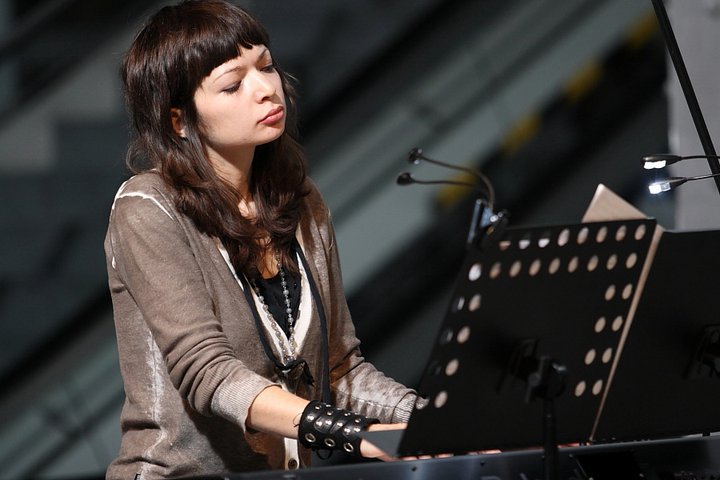
But then I made a real discovery. A professional pianist who "gives" away sheet music of the pop-songs she plays. (Turns out that gives means you are required to make a donation, but whatever.) So I am totally going to get a few and see if I can learn them. Also, watching all her videos made me realise that I don't object to keyboards (and digital pianos) as much as I used to.

Vika Yermolyeva getting a good sway on.
In a completely unrelated turn of events I started listening to my first ever podcast today. Not entirely sure when I am going to get to listen to it, but now I can get clued up on the weekends NFL fixtures before they happen. It features my favourite ever sports-pundit (it's not a long list): Mike Carlson.

Win a trip to Krispy-Kreme (cash value £10). Be the first to correctly comment with what Mike and I have in common. I will give you a clue, it isn't our taste in shirts. 
Another upcoming treat to look forward to is the new season of Masterchef: The Professionals. Featuring beard enthusiast Michel Roux Jnr and his dim-witted sidekick Greg Wallace, it is actually quite entertaining. It also has Monica Galetti in it, who glares at the contestants until they start crying. Masterchef random quote generator says:

There's no place in Masterchef for pink food. There's no place in the world for pink food.

Friday, 19 August 2011

What is information?

So, apparently we live in the information age. But I have never found a satisfactory answer to the question: What is information? I think it is fine to not know at this time. If you went back in time to the iron age (for example) and asked the people there, "what is iron?" they would not hesitate in showing you lots of examples of iron and how they manipulate it. Now we feel we have a better understanding of iron than the people did in the iron age. We know about chemistry and stuff and how atomic properties determine the macroscopic characteristics of iron.

Similarly if you ask about information now, people are very quick to start talking about binary data and the internet and stuff. But there is a lot more to it than that.

\begin{interlude}But first, an example rant on the topic of information in the modern world: Advances in data technology has devalued music. That is not to say that modern music is any less good than it has been in the past. But rather, that as a currency it is worth less. Record companies made shedloads promoting their artists and we all bought their records and the artists enjoyed wealth and fame. But now we can (in principle) all enjoy their music for very little money now that we don't have to produce physical discs any more. I can just re-arrange a few gazillion particles inside my ATX tower (or my phone) and be listening to a hardcore trance mash-up before you can say, "Amy Winehouse". No self-respecting group of greedy music industry CEOs want you to stop giving them money (they wear cowboy hats you know) so we had all that kerfuffle about piracy and stuff. But surely it is an unmaintainable situation. We can't support the cocaine habits of all these people when information (binary data) is so cheep and easy to copy and transport. I suspect in the long run it will be a good thing for music; it will become artistic again, and have less of a mass-produced factory feel to it.\end{interlude}

If you look in a dictionary to find out what information is, you will quickly find there are two separate concepts which share the same word, just to keep things interesting. One is the binary data we all know and love, but there is the unrelated concept of knowledge and meaning. So you can say we live in an age of manipulating binary data, where we can store it and move it in great quantities, but I think we are still struggling to work out what information is. That is a deep philosophical problem.

I wanted to share a link to a factoid I acquired at some stage; the amount of data transmitted over the internet is about 1 exabyte a month. However when looking for said factoid I immediately ran into the problem has been getting me riled up and motivated this post. And that is that you can't measure some things in bytes. Instead of finding what I was looking for, I found a paragraph about how much space it would take to store all the words ever spoken by people, ever. Estimates range from 5 exabytes, to 42 zettabytes depending on if you store it in text or a digitised sound recording. But what are you actually storing? If you record it as text then you are loosing a lot of hesitations and inflections which surely contribute to the intended meaning. And even if you record all the sounds, you loose gestures and expressions.

Sure, you can take all the words ever spoken, and digitize them somehow so that it takes up lots of bytes. You can even undo the process and recover large parts of the intended meaning. But I think it is impossible to do that without loosing some of the intended meaning. And if the process is not completely reversible, what have you got stored in your bytes?

Check out this link, it makes me sad. These are the kind of people who tell you how many bytes it takes to store a person. I really don't see how you can do that when we are still struggling to understand what a person is, with unresolved questions like the mind-body dichotomy. I for one believe that I am not simply the product of electrical impulses in my brain – that I do not exist inside my cranium.

Digital information seems to be stored in specific locations. By this I mean that if you opened up your phone or your hard drive and looked at it hard enough, it is possible to say "this bit of information is stored in this physical location". I expect there are technical reasons why the preceding sentences aren't entirely true, but I am sure the premise is sound. On the other hand, I know all the words to "De Colores" and I strongly believe if you were to dissect my brain you could not say that the first instance of the word "colours" was contained in any specific location. Moreover, I believe it would be possible to remove any individual portion of my brain without affecting my memory in the slightest.. However, like all the best theories, this is completely untestable. You could never be sure you hadn't just removed a part of my brain that has nothing to do with memory.

Even if the things I know are somehow contained in my head (which I am prepared to accept is not the case), then I feel it is likely that each quantum of knowledge is equally distributed over a wide region.

Is information even quantizable? Computer says, "no". It seems nobody has thought to ask this question before. We try quantize everything we can (my favourite is the phonon) and the world is making lots of money out of binary data, so why stop to ask this question?

The concept of steganography is quite interesting and not completely unrelated to what I am trying to say in my post. It is the "art and science" of hiding one message inside another. People get all mathematical about it, looking for redundant bytes inside a file, working out how much extra information you can hide in there (measured in bytes of course) and worrying about the statistical likelihood of different patterns occurring and stuff. Which is great, I like mathematics and shit.

But surely there is another way to do it. Surely it is possible for somebody to say something, but given the correct context and background knowledge it can mean something quite different. I can't deny that the first type of steganography appears in my blog, but I think there is more of this second type.

Check out this topical story. It seems everybody is at it, although 8 billion-to-one is surely an over-estimate. Like how many words (or paragraphs) start with a K? A quick glance through my post reveals zero. And people always do rubbish maths when producing statistics for popular consuption. Sure the chance of 7 random letters spelling that particular word is 267, but what about all the other combintations of 7 letters which could be considered "meaningful".

Final thoughts

Perhaps this image sums up the point I am trying to make, and like my favourite book (and potentially my blog) can be interpreted on several levels. Is it a sequence of 71552 bits of binary data? Maybe it is a picture of an American themed race-track? Maybe it is the numeral zero? Can we attach meanings to any of these interpretations, and how many bytes of information are you actually gaining when you look at it? I like to think that should the right person receive a tiny (in terms of bytes) message then they could attach to it vasts amounts of information.


Tuesday, 28 December 2010

Three CDs

I received three CDs for Christmas this year. They nicely surmise my musical tastes, which are fairly broad. Compare and contrast...

Euphoria - A Decade Of Trance Anthems

Has it really been a decade? That's a long time, I am so old.

Euphoria's first TV advert changed the make-up of how compilations could be presented. In a pioneering  move it featured just one track. Faithless' "Insomnia" reaching the climax of its breakdown just as vertical lines on the screen slowly became the letters spelling out its title.

Apparently that was autumn of 1999 and I can remember it. I guess I was 19. Back in the day I glimpsed how this music should be done: big rooms, sweeping coloured lasers and groups of people being brought together in an overriding sense of elation. But music has changed since then, those days are gone. Instead of mostly European DJs playing the sort of music that made people happy and brought them together, we get mostly American DJs and rappers telling everybody how cool they are. For a while I thought I could go out and experience those times again, that the only thing stopping me was that I didn't go clubbing so often. I assumed that when I did go clubbing I was just missing the good clubs, playing the sort of music I wanted. But I now realise that that music is in the past.


Bach - the Art of Fugue & Musical Offering
Recently I have started re-reading GEB, which inspired me to ask for this CD. The book makes innumerable references to Bach, and these works in particular. They are exemplars of Bach's fugal writing, a style which didn't stay in fashion much after his death. Unlike the other CDs I got, I didn't know any of the tracks on this one before I got it (apart from the snippets discussed in GEB) and I wouldn't exactly describe them as catchy. Having read a little about these pieces before I listen to them I know the sort of techniques Bach uses to construct these pieces from their subjects. Having played several Bach fugues I know in general terms how they are put together, but I also know that these have extra special tricks in them, like inversion, augmentation and all that gubbinry. This music is the sort of music where I want to set time aside to listen to it - I don't want to be multitasking trying to do something else at the time. It deserves my full attention so I can try and pick out all the subject entries and the clever things Bach is doing (surely a difficult task). That is not to say that I don't put it on and do something else - I am listening to it now as I write this, but out of all the CDs, this one has the most to reveal under close scrutiny.

Ludovico Einaudi - Nightbook

This was the only music I got that had a title - the others simply have descriptions of the contents. (You could argue "Euphoria" is a title - but it is billed that "Euphoria" is the artist (being an ongoing range of compilation CDs) and "A decade of Trance Anthems" is the title of this one.) Nightbook is also the most "poppy" CD I received. Even though it is "classical" is style (I heard about it on Classic FM) I feel it reaches to the broadest audience and comes in nice bite-size pieces each 3-5 minutes long - convenient for the modern busy listener.

Jean-Luc Picard loves his Shakespeare, and introduced me to the concept of Method acting when he discusses Data's performance of Henry V. As I understand it, in regular acting the actor simulates the emotions their character is supposed to be feeling by changing their voice and waving their arms around and stuff (see emoting). Whereas in Method acting the actor feels the emotions first and then uses this in their portrayal of the character. They do this by drawing on their own past experiences. So we have a choice between which comes first, the emotions or the portrayal, and we can also consider which makes the better acting. But that is not a question for me to tackle - I don't really get acting. I much prefer films with a car chase and gratuitous nudity.

One can ask if there is a parallel situation with music. Do I listen to chill-out music when I am already chilled or to relax me? Do I listen to my banging rave anthems when I want to do something frantic (e.g. Starcraft!) or when relaxing too much would be dangerous (motorway driving)? In my case, I reckon I listen to my dance music when I want to be alert and on the ball, but I don't listen to chilled music to relax. I reckon when I get chance to relax I am going to chill out whatever I am listening to. I don't think I listen to happy music to make my happy, and I certainly don't think anybody would listen to "sad" music with the intention of getting depressed. I reckon that the reason bands like the Manics and Radiohead are associated with depression and suicide and whatnot, is because people are depressed anyway and choose music that might strike a chord with what they are feeling. And it is a special thing to experience an emotional connection with someone through music.